
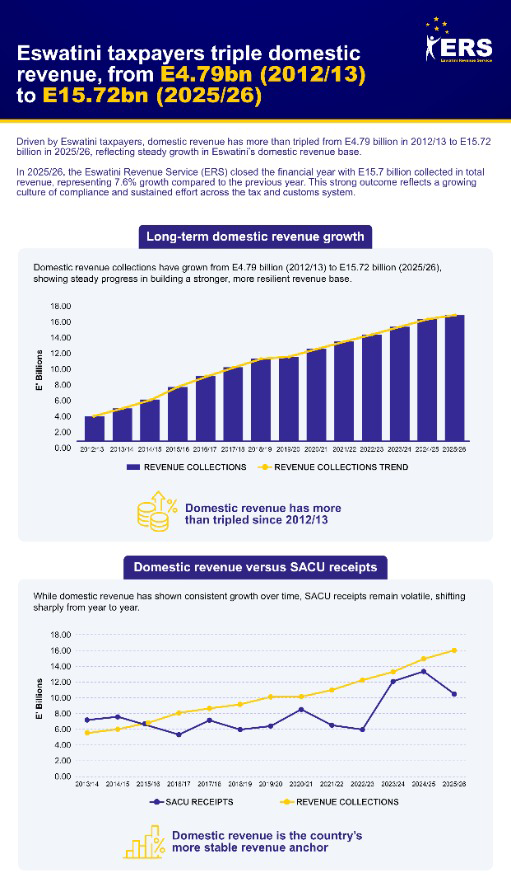
Eswatini’s domestic tax revenue base has more than tripled over the past decade, with collections rising from E4.79 billion in the 2012/13 financial year to E15.72 billion in 2025/26, according to the Eswatini Revenue Service (ERS).
The Revenue Service ended the 2025/26 financial year with total collections of E15.7 billion, a 7.6% increase from the previous year.
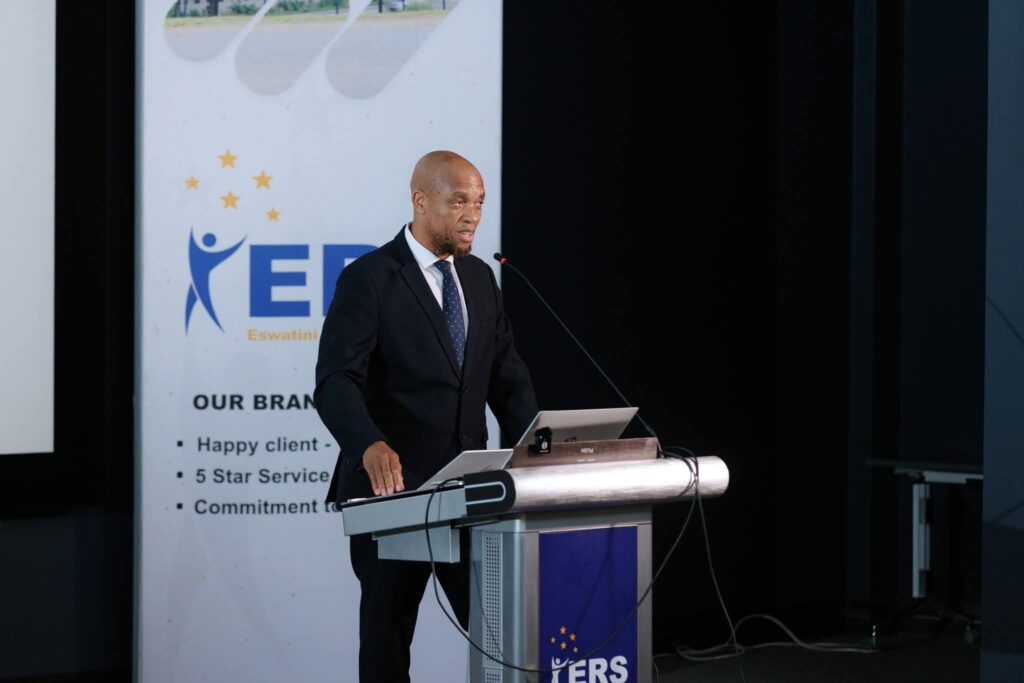
ERS Commissioner General Brightwell Nkambule said the performance reflects disciplined execution across domestic tax and customs operations, sustained taxpayer engagement, and consistent staff efforts. He noted that the results underscore the critical role of taxpayers in funding government programmes and national development priorities.
Beyond the annual figures, ERS’s long-term performance demonstrates steady, resilient growth in domestic revenue collection. The year-over-year increase indicates a growing ability for Eswatini to finance its national priorities with internally generated resources, reducing dependence on external revenue sources.
This shift occurs as receipts from the Southern African Customs Union continue to fluctuate significantly. SACU revenues fell by 20.4% from E13.07 billion in 2024/25 to E10.40 billion in 2025/26, highlighting the volatility of this revenue source. Meanwhile, domestic revenue has maintained a steady upward trend, offering a more stable basis for government planning and service delivery.
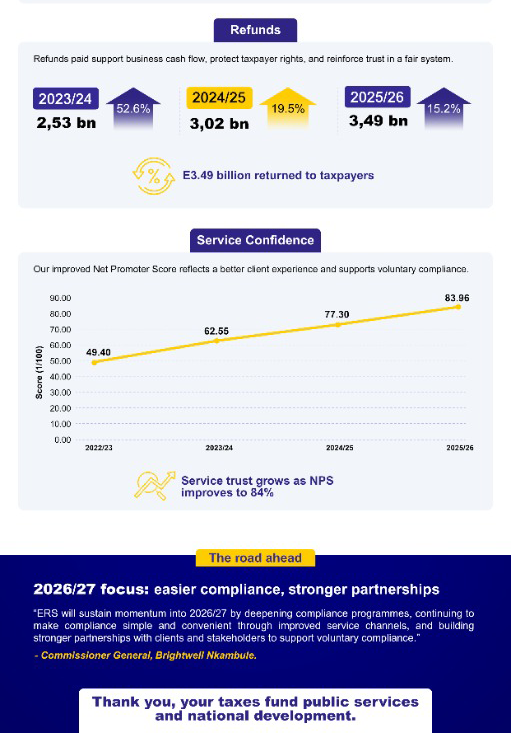
ERS also emphasized its commitment to maintaining a fair and credible tax system by providing timely refunds. During the reporting period, the agency distributed E3.49 billion in refunds, including E3.48 billion in Value Added Tax (VAT) refunds and E6.37 million in income tax refunds. These payments are essential in protecting taxpayer rights, supporting business cash flow, and building trust in the tax system.
Service delivery improvements have also led to stronger compliance. ERS recorded a Net Promoter Score (NPS) of 83.96% for 2025/26, up from 77.3% the previous year, indicating increasing customer satisfaction and confidence in its services. The authority plans to introduce additional feedback channels to further boost client engagement and service quality.
Looking ahead, Nkambule said ERS will focus on expanding compliance programs, streamlining tax procedures through better service channels, and enhancing partnerships with taxpayers and stakeholders.
“We sincerely thank our compliant taxpayers and traders whose contributions keep the country working,” he said. “Our focus is clear: protect the tax base, improve fairness, raise service standards, and strengthen compliance so that the country can fund its priorities with certainty.”