
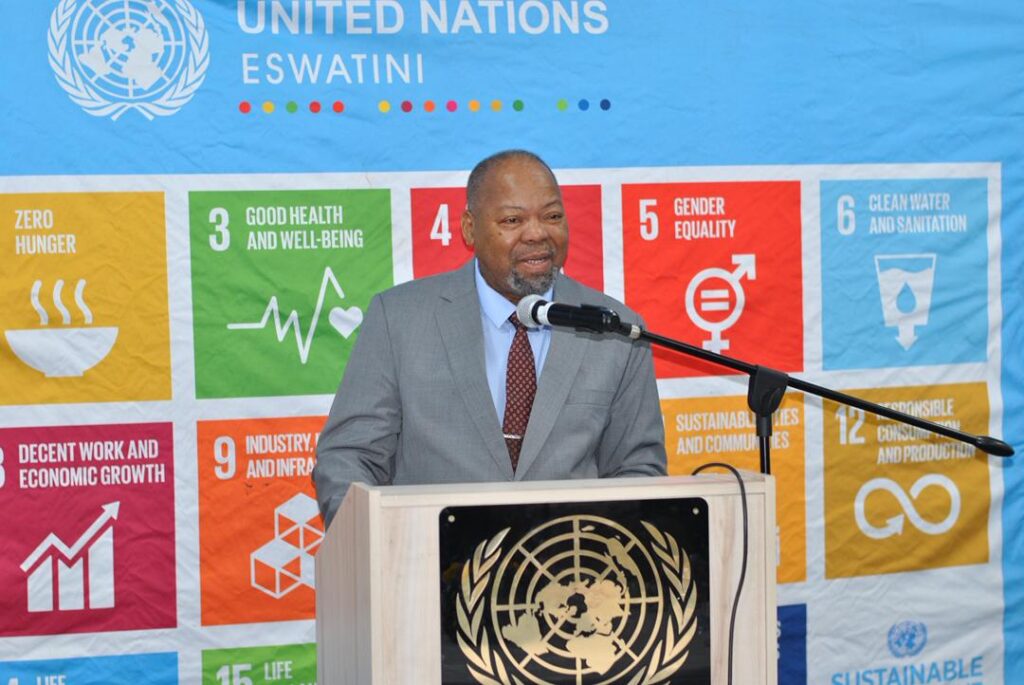
Minister of Economic Planning and Development, Dr Tambo Gina has called for urgent and collective action to tackle poverty, unemployment and inequality as Government and the United Nations launched the Joint National Steering Committee (JNSC) for the 2026–2030 United Nations Sustainable Development Cooperation Framework (UNSDCF).
Speaking during the inaugural session held at the UN House in Mbabane on Thursday, Dr Gina warned that the country could not afford delays in implementing development programmes aimed at improving the lives of emaSwati.
“With roughly 58.9 percent of our people living in poverty, youth unemployment exceeding 50 percent, and our Gini coefficient remaining amongst the highest in the world, we must act with relentless urgency,” he said.
The minister described the launch of the steering committee as more than a routine meeting, saying it marked the beginning of collective responsibility in ensuring that commitments made under the cooperation framework are translated into practical and measurable results.
“This occasion marks a defining moment rather than a routine meeting — the first formal act of collective stewardship for a cooperation framework embodying the deep partnership between the Government of the Kingdom of Eswatini and the United Nations Development System,” he said.
Dr Gina reminded stakeholders that five months ago Government and the UN officially signed and launched the Sustainable Development Cooperation Framework 2026–2030, adding that the country was now entering the implementation phase.

“Today, we take our first decisive step forward: turning our shared commitments into concrete, time-bound and accountable action plans,” he said.
The minister further stressed that His Majesty King Mswati III’s call of “Nkwe!” should guide every structure, plan and action under the framework.
According to Dr Gina, Government and the UN Country Team have already finalized costed Joint Work Plans for the 2026–2027 period and established a whole-of-government coordination structure to strengthen accountability and implementation.
He explained that the Joint Work Plans were not merely administrative documents, but practical tools intended to deliver real impact in sectors such as health, education, governance and economic development.
“Far from being mere administrative requirements, these plans are the engines of our partnership,” he said.
Dr Gina also urged line ministries, central agencies, development partners and civil society organisations to take ownership of the process and ensure that implementation becomes part of their daily work.
“My directive to the line ministries and central agencies present here is: own this process and embed it into your daily work,” he said.
He added that Government’s commitment to lead the process remained firm, but success would require accountability, collaboration and sustained support from all stakeholders.
“We are here to ensure the 2026–2030 Cooperation Framework becomes a reality, not just a document on a shelf,” said the minister.