

By Phiwa Sikhondze
The Eswatini Revenue Service (ERS) is powering through with its digital transformation drive. The organization says digitalization will simplify tax compliance, reduce enforcement, and reposition the organization.
ERS Commissioner General, Brightwell Nkambule, highlighted the organization’s ambition to automate the core processes of registration, declaration, and payment, aiming to make them fully autonomous through the implementation of disruptive technologies.
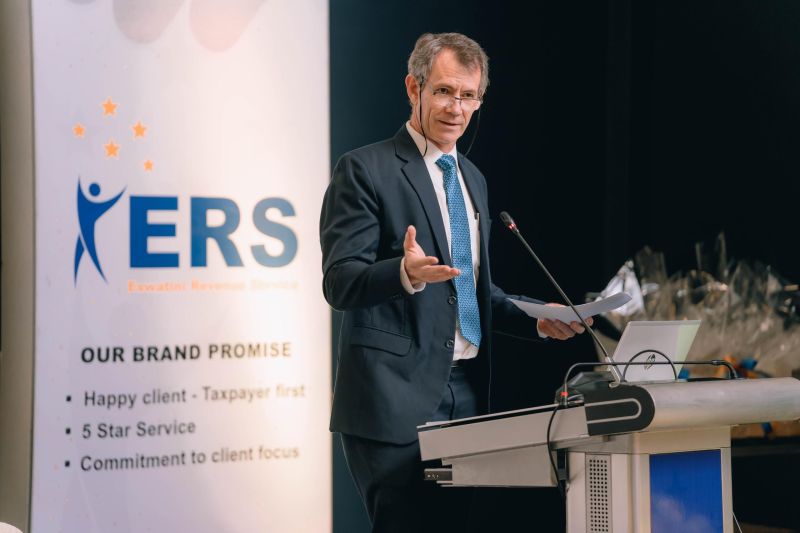
Nkambule stated this during the ERS Digital Roadmap Symposium 2024 held at their headquarters yesterday. The CG moderated a panel comprising ERS Commissioner of Domestic Taxes, Dumisani Ngcamphalala, ERS Acting Head of Business Strategy, Sakhamuzi Mthunzi, ERS Chief Financial Officer, Thobile Dlamini, and ERS Commissioner Customs & Excise, Gugu Mahlinza.
“Our digital ambitions are centered around automating these three processes to the extent that they become autonomous. Technology will handle the hard work, allowing us to focus on advising and partnering with our clients,” Nkambule stated.
Vusi Ngcamphalala, Commissioner of Domestic Taxes, opened the discussion by explaining the seamless registration program. The initiative seeks to integrate ERS systems with those of the Registrar of Companies and Municipal Councils, enabling businesses to receive a Tax Identification Number (TIN) automatically upon registration.
“This means taxpayers will no longer need to visit ERS offices to register. Instead, our systems will communicate with the registering entities to issue TINs,” Ngcamphalala said.
The program aims to reduce compliance costs and eliminate penalties for late registration. By leveraging data-driven processes, ERS hopes to detect unregistered taxpayers and ensure they are seamlessly integrated into the tax system without coercive measures.
Sakhamuzi Mthunzi, Acting Head of Business Strategy, discussed the transformed declarations program, emphasizing the introduction of pre-populated tax returns.
“We want businesses to experience the same simplicity as individuals under PAYE, where taxes are automatically calculated and reflected on their pay slips. Our system will pre-populate returns, reducing the need for manual filing,” Mthunzi explained.
This innovation is expected to enhance accuracy and ease the burden of compliance for taxpayers.
Nkambule emphasized the importance of collaboration with other public entities to achieve these digitalization goals. By sharing data and integrating systems, ERS aims to build a comprehensive framework that reduces compliance barriers and fosters voluntary compliance.
“We are moving away from coercive to persuasive measures. Our goal is not to penalize but to make compliance so simple that enforcement becomes unnecessary,” he noted.
Emphasizing the significance of compliance, the CG highlighted that the compliance gap in the country is E4.5 billion. “If everyone would comply, we would have E4.5 billion more,” he said.

“This transformation is more than just a technological upgrade; it’s a reimagining of how we serve our clients and the nation,” Nkambule concluded.
Echoing the CG the Minister of Finance, Neal Rijkenberg, underscored the critical role of digitalization in modernizing tax systems. “Digitalization is a cornerstone of efficient and effective revenue collection. These advancements are not just about efficiency; they represent a broader commitment to fostering a thriving and compliant economy,” he stated. Highlighting ERS’s alignment with His Majesty’s “Nkwe for Growth” call, the Minister noted how digital solutions could drive innovation and inclusivity in revenue administration.