
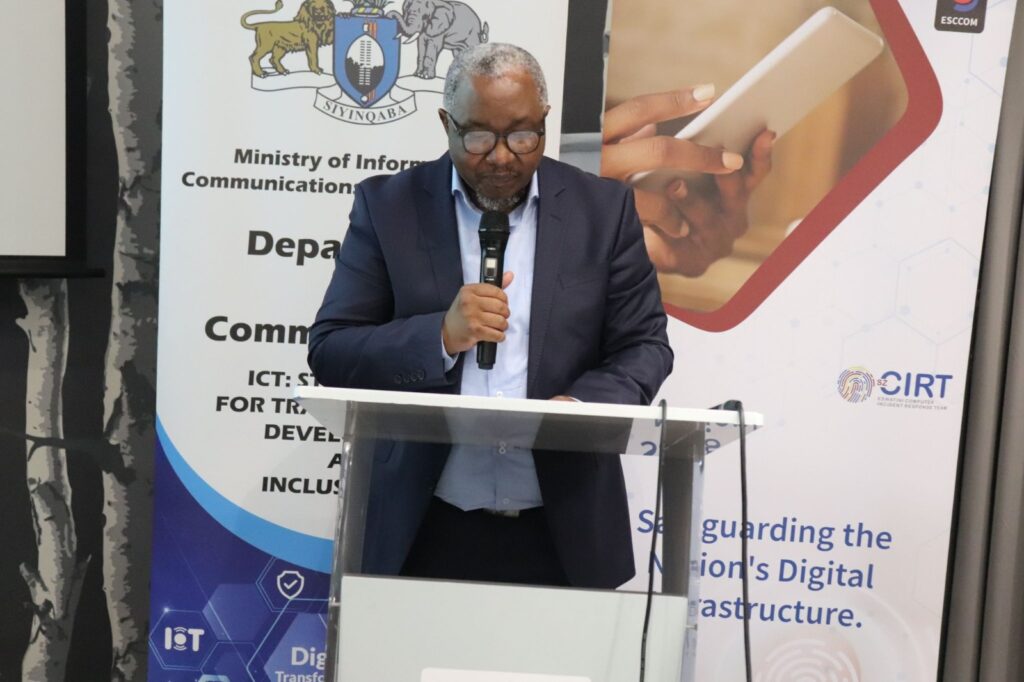
By Sizwe Dlamini
The Chief Executive of the Eswatini Communications Commission (ESCCOM), Mvilawemphi Dlamini says that they are committed to bolstering Eswatini’s cyber defenses and enhancing digital safety in the country.
He disclosed this at the Cybercrime Workshop for Prosecutors and Law Enforcement held at the Hilton Garden Inn in Mbabane, yesterday.
Dlamini highlighted the enactment of the Computer Crime and Cybercrime Act of 2022, which designates ESCCOM as the body responsible for coordinating cybersecurity efforts across the kingdom.
Dlamini stated that the Computer Crime and Cybercrime Act of 2022, enforces ESCCOM’s commitment to creating a safer digital environment for all citizens. Since the passage of this act, the Commission has engaged with various stakeholders and taken significant steps to ensure that its strategies and frameworks effectively combat cybercrime.
Dlamini further highlighted the alarming rise in cybercrime, which has resulted in citizens losing millions in funds and infrastructure daily.
Despite progress in apprehending criminals, Dlamini noted that law enforcement agencies require further capacity building to navigate the new legislative frameworks and address the complexities of cybercrime effectively.
“Our law enforcement agencies are facing serious challenges. We must equip ourselves with the necessary tools to combat this menace,” he said.
Dlamini added that the workshop aligns with the National Cybersecurity Strategy 2022/2027, aimed at enhancing the understanding of cybercrime among prosecutors and law enforcement officers.
“Let us outline several key areas of focus for the workshop first. Understanding the most prevalent types of Cybercrime: Exploring various categories of cybercrime and their specific impacts on the nation. Secondly, International Treaties and Legislative Frameworks: Providing an overview of applicable international treaties and local legislation governing cybercrime investigation and prosecution in Eswatini. Thirdly, Cyber Investigations and Intelligence: Discussing effective methods for cyber investigations, the importance of electronic evidence, and the benefits of a multi-disciplinary team approach. Fourthly, Value of Standard Operating Procedures: Understanding how formal guidance documents can serve as invaluable resources for law enforcement and the judiciary,” he said.
Meanwhile, the Principal Secretary (PS) in the Ministry of ICT, Phesheya Dube, emphasized the need for collaboration in addressing the evolving challenges of cybercrime. “The workshop is not merely a gathering of legal minds; it is a proactive measure aimed at equipping participants with the tools necessary to confront the harsh realities of cybercrime,” he stated.
Dube acknowledged the rapid evolution of cyber threats and stressed the importance of ongoing education for judiciary members and law enforcement professionals. “Your willingness to engage with the Computer Crime and Cybercrime Act, as well as the Data Protection Act of 2022, reflects your enduring commitment to justice and public safety,” he noted.
He added that the timing of the gathering was especially significant, coinciding with the conclusion of National Cybersecurity Awareness Month, themed ‘Asiphepheni, Secure Our World.’ Dube commended the efforts of stakeholders in educating citizens about online safety and promoting mechanisms for reporting cyber incidents.

“The campaign has effectively reached every corner of society, fostering a culture of cyber resilience through school visits, podcasts, webinars, and targeted training sessions,” he remarked.
Dube highlighted the unique aspect of the workshop: the acknowledgment of collaborative efforts driving cybersecurity initiatives. “The partnership with the United States, facilitated by the US Embassy, has bolstered the nation’s capacity to secure its digital infrastructure. We look forward to continuing this partnership, grounded in mutual respect and a shared vision for a safer, more secure digital future,” he concluded.