
By Ayanda Dlamini
The Eswatini Stock Exchange has entered into a partnership with the Nairobi Stock Exchange, one of Africa’s leading exchanges.
The signing of a Memorandum of Understanding (MoU) between the Eswatini Stock Exchange (ESE) and the Nairobi Securities Exchange (NSE) is expected to deliver far-reaching benefits for Eswatini’s capital market, investors, and the broader economy as the country deepens its integration into regional and continental financial markets.
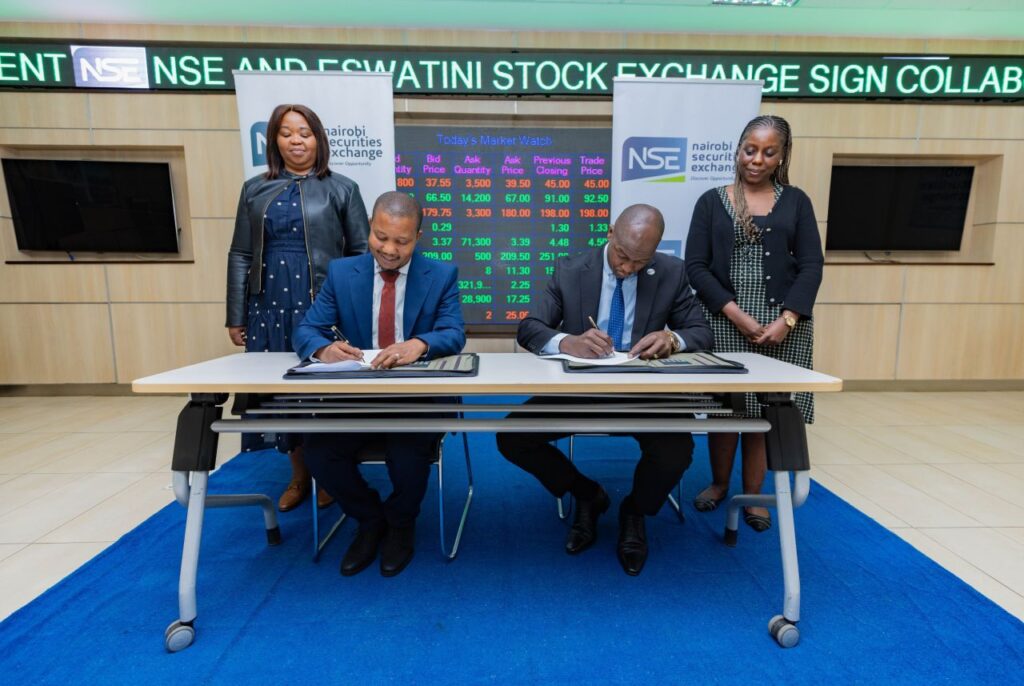
The MoU, signed on February 4, 2026, establishes a formal framework for cooperation between the two exchanges, covering information sharing, market development, capacity building, innovation, and strategic collaboration.
For Eswatini, the agreement marks a significant step toward strengthening its relatively small yet growing capital market by leveraging the experience and scale of one of Africa’s most established exchanges.

Commenting on the partnership, ESE Acting CEO Sihle Tsabedze said the agreement marked an important milestone for the local market. “This MoU is a strategic move for the ESE as we seek to strengthen our market infrastructure, enhance our product offering, and position Eswatini more competitively in the regional capital markets landscape,” Tsabedze said.
The NSE, founded in 1954, is a leading African exchange offering a diverse range of listed products, including equities, government and corporate bonds, exchange-traded funds (ETFs), real estate investment trusts (REITs), and derivatives.
Its depth, liquidity, and technological sophistication make it a valuable strategic partner for the ESE as it advances its modernization agenda.
One of the most immediate benefits for Eswatini is capacity building and skills transfer. Through structured training programs, workshops, and staff exchanges, ESE personnel will gain exposure to best practices in trading systems, market surveillance, listings, and investor relations.
According to Tsabedze, this knowledge transfer is central to the partnership’s objectives. “By working closely with the NSE, our team will gain hands-on experience in mature-market operations, thereby strengthening our institutional capacity and improving the ESE’s overall efficiency and credibility,” he said.



The partnership also opens the door to market development initiatives, including the exploration of cross-listing opportunities. For Eswatini companies, cross-listing on the NSE could increase visibility, improve access to a broader pool of regional and international investors, and potentially lower the cost of capital.
Tsabedze noted that cross-border listings could be transformative for local issuers. “Cross-listing offers Eswatini companies access to deeper pools of capital while raising their regional profile. At the same time, it expands investor choice and encourages cross-border capital flows,” he said.
Investor education and participation are another key area of potential impact. By collaborating on joint promotional activities and sharing investor engagement strategies, the ESE can draw on the NSE’s experience in expanding participation among retail and institutional investors.
In the area of innovation and technology, cooperation with the NSE is expected to support Eswatini’s efforts to adopt digital platforms and fintech solutions that enhance market access and transparency.
“Technology and innovation are critical to the future of capital markets. This partnership allows us to learn from the NSE’s digital transformation and accelerate our efforts to make the market more accessible and efficient,” Tsabedze said.

From a regulatory perspective, the MoU provides a platform for ongoing dialogue to align standards with international best practices while respecting each market’s legal and regulatory framework.
The MoU was witnessed by the ESE Board of Directors and senior management during an official visit to Nairobi, underscoring the partnership’s implementation-focused nature.
A joint working group will oversee the rollout of agreed-upon initiatives and identify new areas for collaboration.
Overall, the ESE–NSE partnership is expected to strengthen Eswatini’s capital market ecosystem, enhance investor confidence, and support long-term economic growth by positioning the country as a more connected and competitive participant in Africa’s financial markets.