

By Ayanda Dlamini
The Government of the Kingdom of Eswatini has secured E 953 million (US$59.2 million) in financing to implement the Eswatini Water Supply and Sanitation Access Project (EWSSAP), a flagship infrastructure initiative that strengthens national water security and expands sanitation services in the Shiselweni Region.
The funding agreement, signed with the International Bank for Reconstruction and Development (IBRD) of the World Bank, comprises E853 million (US$53 million) from the World Bank and a government contribution of E99.8 million (US$6.2 million).
The co-financing model underscores Eswatini’s position not merely as a recipient of development assistance but as an active investor in long-term infrastructure resilience.
The project is implemented by the Eswatini Water Services Corporation (EWSC) under the Ministry of Natural Resources and Energy and delivered in collaboration with the Department of Water Affairs, the Ministry of Health’s Environmental Health Department, and the National Disaster Management Agency.


The project targets the Nhlangano–Siphambanweni corridor in the Shiselweni Region, an area historically vulnerable to drought and water scarcity.
At the core of the initiative is the Resilient Water Access and Management component, which comprises the construction of three reservoirs, one pump station, and a 66-km bulk water pipeline connecting Nhlangano to Siphambanweni.
One major infrastructure package has already been completed, another is nearing completion, and the final phase is advancing to extend supply deeper into surrounding communities.
Beyond physical infrastructure, the project also advances institutional reforms and policy frameworks, including progress on the National WASH Master Plan, the development of the Mkhondvo River Health Management Systems, and Water Act reforms to strengthen drought preparedness and water governance.
Expanding Sanitation and Public Health Outcomes

In parallel, the Improved Sanitation Access component is delivering sanitation facilities to schools, health centres, informal settlements, and rural households across Shiselweni.
The integrated model ensures that water supply expansion is aligned with dignified sanitation solutions, thereby improving health outcomes and environmental sustainability.
A third pillar of the project focuses on institutional strengthening and project management, reinforcing governance systems, fiduciary controls, and environmental and social safeguards to ensure accountability and long-term sector stability.
Nomahlubi Matiwane, the Director of Business Enablement and Corporate Affairs at EWSC, speaking on behalf of Managing Director Jabulile Mashwama, said the initiative is a strategic investment in the country’s economic future.
“Water security underpins economic growth, food production, public health, and social stability. Through EWSSAP, we are not merely expanding infrastructure; we are building resilient systems that can withstand climate shocks and sustain productivity for generations,” she said.
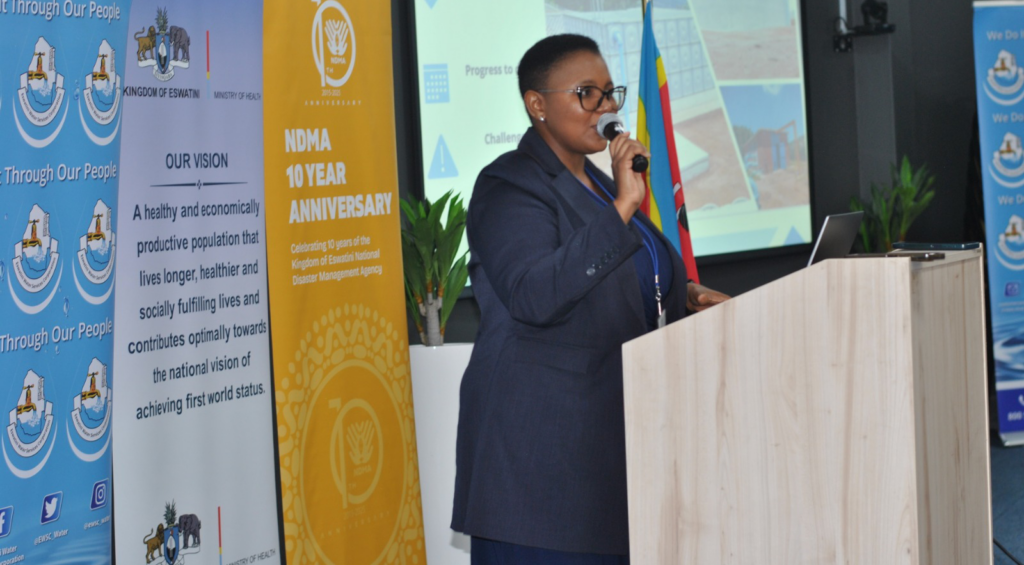

She added that the co-financing structure demonstrates strong domestic commitment and international partnership. “This project reflects the government’s role as a co-investor in sustainable development. It shows that we are committed to safeguarding the dignity and well-being of emaSwati while strengthening institutional capacity and long-term resilience.”
A Model of Coordinated Development
As climate variability intensifies across Southern Africa, investment in resilient water systems has become a strategic economic imperative.
The EWSSAP positions Eswatini to mitigate drought risk, stabilise domestic and commercial supply, and support inclusive growth in vulnerable regions.
With implementation progressing steadily, the project stands as a high-impact public infrastructure investment that aligns national priorities, institutional reform, and international financing toward sustainable development outcomes.