
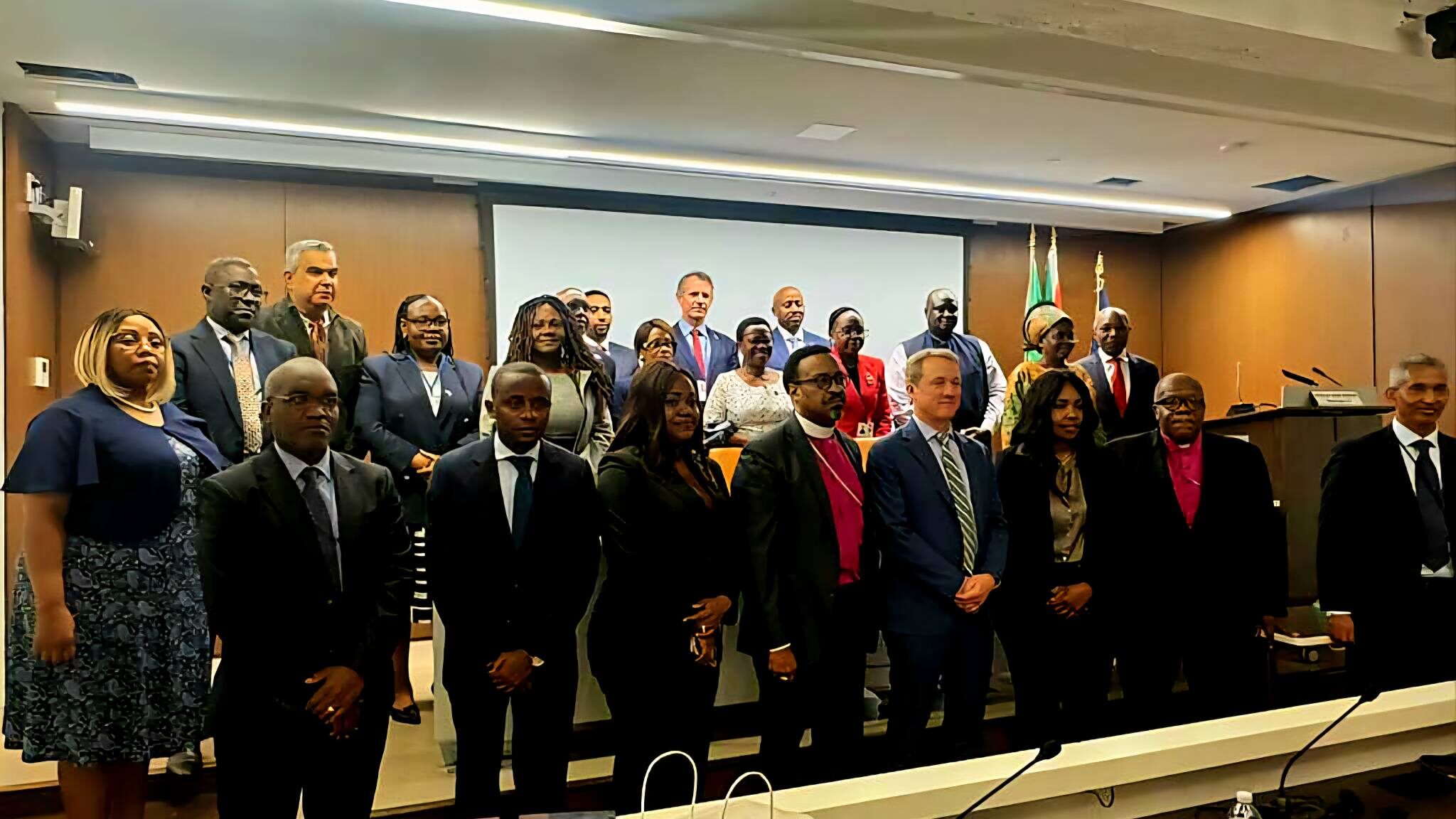
In a high-level convening at the African Union Mission to the USA, the Minister for Finance Neal Rijkenberg, acting in his capacity as Chairperson of the AU Specialized Technical Committee (STC) on Finance, Planning, Economic Integration, and Monetary Affairs, has delivered a roadmap for the continent’s economic evolution.
Addressing a global audience of delegates and policymakers, the Minister framed digital and financial inclusion not merely as technical goals, but as the fundamental engines for large-scale job creation in an increasingly young Africa.
The Minister highlighted a paradox, where over half of Africa remains unbanked or underbanked even as mobile penetration continues to surge. He described this gap as a powerful opportunity to leapfrog traditional development constraints and build inclusive, technology-enabled economies. “Inclusion is not an end in itself; it is a catalyst for jobs,” the Minister noted, emphasizing that when small and medium-sized enterprises gain access to digital platforms and credit, they grow and hire, ultimately transforming entire economies.
With Africa projected to house one in every four people on earth by 2050, the Minister urged a shift in perspective regarding the youth demographic. He stated firmly that the discourse of youth employment needs to shift from seeing young people as a threat or a risk, and instead recognize them as “an opportunity, an asset and also a champion for transforming the continent with their vast talent, energy and boundless creativity.” To harness this energy, the Chairperson outlined a multi-pillared strategy focusing on digital infrastructure as a public good, interoperable financial systems to support the AfCFTA, and forward-looking regulation that protects consumers without stifling fintech innovation.
In a significant policy announcement, the Minister revealed that the Kingdom of Eswatini has moved from theory to action by investing in the Africa Strategic Investment Alliance (AfSIA). Hosting the regional headquarters for the alliance, Eswatini is launching a pilot project designed to serve as a vehicle for industrial development and a springboard for exports. The Minister emphasized that while the AfCFTA is a Pan-African endeavor, its implementation must be largely driven by domestic resources. He argued that while the continent can catalyze resources from partners, “this should not be the primary source of funding.”
The Minister championed the AfSIA and Sokokuu Integrated Ecosystem as the most pragmatic approach to continental integration, calling on fellow Member States to join as founding members to shape a strategic direction aligned with national priorities. He observed that while the underlying ideas for such initiatives are noble, they require a “strong political will to move forward.” Success, he argued, depends on sustained collaboration between governments, private sector innovators, and regional economic communities to mobilize resources and scale solutions.
Concluding his remarks with a sense of urgency, the Minister challenged the delegation to move past the ideation phase that has historically slowed continental progress. “Africa does not lack ideas. What we require now is execution at scale,” he said. By commitment to turning policy into implementation and innovation into inclusion, the STC Chairperson believes the continent can finally unlock its full economic potential and deliver dignity, opportunity, and prosperity for all its people.