

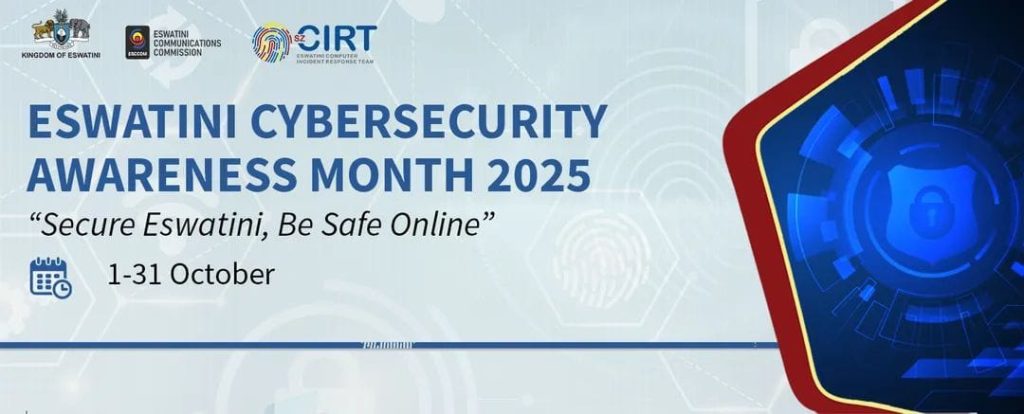
The Eswatini Communications Commission (ESCCOM), in collaboration with the Ministry of Information, Communications, and Technology (ICT), has officially launched the 2025 edition of National Cybersecurity Awareness Month, held every October to intensify nationwide education on digital safety.
This year’s campaign, themed “Secure Eswatini, Be Safe Online,” underscores the shared responsibility of citizens, businesses, and government in safeguarding the kingdom’s digital space.
Throughout October, ESCCOM and its partners will host school outreach programmes, business and government workshops, webinars, and multimedia campaigns across radio, television, print, and social media. Educational materials such as flyers and cybersecurity toolkits will also be distributed to ensure inclusivity across both urban and rural communities.
The importance of this campaign cannot be overemphasized. According to ESCCOM’s 2025 Annual Report, online fraud and mobile wallet scams dominated reported offences in 2024. The notorious “Facata” scam alone defrauded EmaSwati of more than E2.5 million in just 12 months. Other serious incidents included business email compromises, ransomware attacks, cyberbullying, and online harassment.
Despite these threats, progress has been made in strengthening the country’s cybersecurity frameworks. The National Cybersecurity Agency (NCA) last year rolled out the “Asiphepheni, Secure Our World” campaign, reaching more than 3,700 pupils and enrolling 486 citizens – including 100 civil servants – in free online cybersecurity courses. The Eswatini Data Protection Authority (EDPA) also advanced its oversight role by issuing guidance notes to help businesses comply with the Data Protection Act, covering areas such as personal data processing, surveillance technologies, and internal privacy compliance.
On the international front, Eswatini signed a Memorandum of Understanding (MoU) with Botswana’s Cybersecurity Incident Response Team and secured World Bank funding to build national capacity, including the development of a Computer Security Incident Response Team (CSIRT) action plan.
A CSIRT framework equips the country to detect, respond to, and recover from cyber incidents such as ransomware, data breaches, and fraud
However, ESCCOM’s report highlights that significant gaps remain. The Royal Eswatini Police Service (REPS) admitted it lacks the technical expertise to investigate sophisticated cybercrimes or present digital evidence in court. Stronger public-private partnerships and deeper international cooperation are therefore seen as critical to closing these gaps.
Citizens are being urged to play their part by adopting basic safety practices such as using strong passwords, enabling two-factor authentication, staying alert to digital scams, and reporting all suspicious activity to law enforcement.
With threats ranging from identity theft to AI-driven scams and low digital literacy, ESCCOM stresses that businesses must prioritise staff training, robust data protection, and modern security systems.
The 2025 awareness drive has drawn wide support from government agencies, UNESCO, service providers, critical infrastructure operators, the Royal Eswatini Police Service, and non-governmental organisations, marking a united effort to build a safer digital future for the kingdom.
The official launch of the 2025 campaign is scheduled for 6 October.