

The Central Bank of Eswatini (CBE) has confirmed that zero uncontrolled dye-stained Emalangeni banknotes successfully breached public circulation over the past financial year. The containment arrives despite an aggressive wave of automated teller machine (ATM) bombing incidents across the country.
The banking regulator in Governor Dr. Phil Mnisi’s annual policy statement revealed that following recent high-profile ATM detonations in Mpaka and Mankayane, the Royal Eswatini Police Service retrieved and submitted 3,495 dye-stained banknotes to the CBE for forensic authentication. Laboratory assessments successfully verified that 100 percent of these notes were the direct proceeds of physical infrastructure crimes.
However, while cross-border transactional migration allowed 133 uncontrolled dye-stained South African Rand (ZAR) banknotes to filter into the local ecosystem, the domestic defense system held completely firm, preventing a single compromised Emalangeni note from being integrated into retail commerce.
CBE has issued an urgent public advisory emphasizing that the security architecture protecting the nation’s currency relies on an uncompromising, irreversible defacement standard.
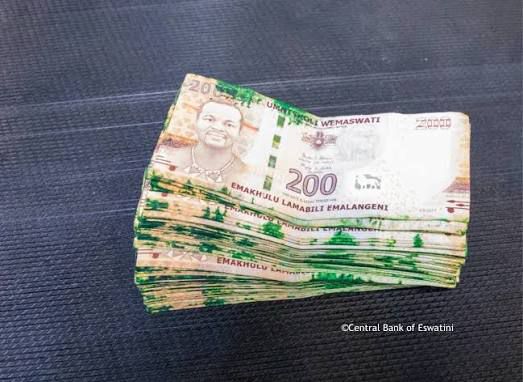
Inside Eswatini’s ATM networks, the officially mandated security defense utilizes a specialized green dye-staining ink. In the event of an unauthorized or explosive breach, the system instantly detonates, permanently staining and instantly stripping the banknotes of their legal tender status.
The Central Bank noted that while neighboring South Africa is currently phasing out its legacy green systems to transition to a blue dye-staining ink, green remains the active legislative standard inside Eswatini.
Consequently, the public is strongly warned that any Lilangeni note bearing green ink marks is a direct byproduct of criminal activity. Retailers, informal traders, and consumers are strictly advised to reject these notes out of hand and report any handlers to law enforcement immediately.
According to the Governor, CBE simultaneously executed an aggressive operational efficiency drive at the foundational level of cash management.
Through its innovative coin management efficiency project, the Central Bank has mounted an incredibly successful campaign against local coin hoarding, significantly driving down national minting expenditures.
The bank successfully collected and recirculated approximately E42 million in coins during the 2025/26 financial year, up from E37.8 million the previous year.
However, despite these operational gains, the Central Bank has renewed its public appeal to halt practices that artificially constrain market liquidity.
“The public is strongly urged to refrain from hoarding coins and to recognize the vital structural value of low-denomination coins—particularly the 10-cent piece—in facilitating seamless daily commerce across the wider economy,” the Governor states.
The regulator attached a specific, stern warning against the persistent utilization of national currency in religious, traditional, or cultural rituals. He deemed them as practices that permanently damage or remove metallic currency from active economic circulation, forcing the state to incur avoidable replacement costs.