
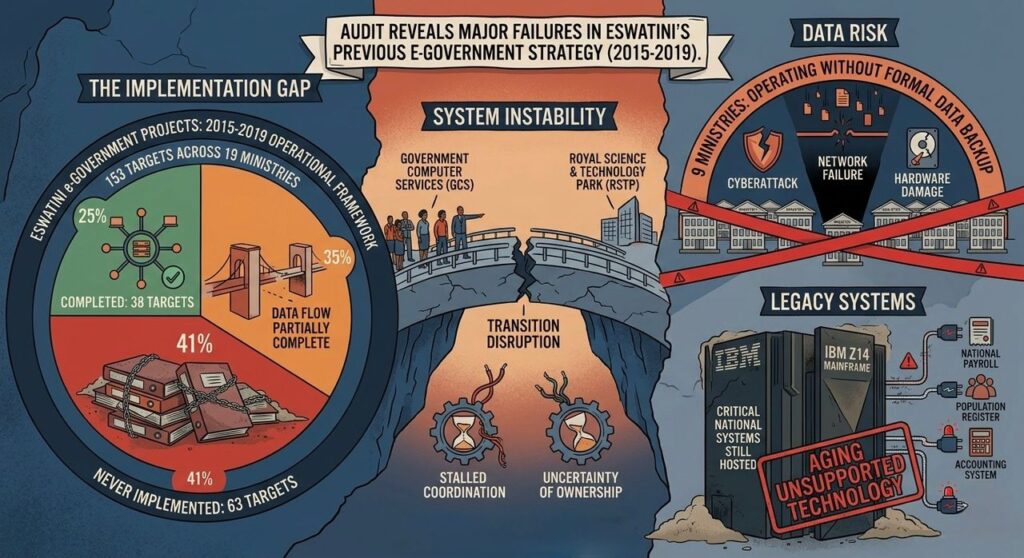
The recently presented Digital Landscape Assessment Report by the Ministry of Information Communications and Technology has revealed that nearly three-quarters of Eswatini’s planned e-Government commitments under the 2015-2019 national framework were never fully implemented, exposing major weaknesses in the country’s digital transformation programme.
According to the report, the 2015-2019 e-Government Operational Framework identified 153 digital transformation targets across 19 ministries. However, only 38 commitments, representing 25%, were fully achieved.
The assessment found that 35% of the targets were only partially completed, while 41% were never implemented at all.
The report states that the low implementation rate has contributed directly to the Kingdom’s overall digital maturity score of 1.9 out of 4, leaving public administration largely trapped within a “Developing” phase.
The audit identified the institutional transition from Government Computer Services (GCS) to the Royal Science and Technology Park (RSTP) as one of the key factors that disrupted implementation of the previous framework. According to the report, the transition created uncertainty around project ownership and weakened technical coordination across ministries, causing several cross-government systems to stall.
The assessment also highlighted serious concerns around data security and institutional resilience within government systems. 9 ministries were found to be operating without formal data backup systems, exposing critical public information to potential loss in the event of cyberattacks, network failures, or hardware damage.
The report further warns that several critical national systems, including the National Payroll, Population Register, Accounting System, and Central Motor Registry, are still hosted on an aging IBM Z14 mainframe operating on software no longer supported by vendors.
To address the weaknesses, the report recommends the introduction of legally binding ICT strategies across all government institutions, alongside formal Service Level Agreements between ministries and the Royal Science and Technology Park. The recommendations are intended to improve accountability, strengthen technical support structures, and ensure better coordination in future e-Government implementation.