

The Central Bank of Eswatini (CBE) has revealed a contraction in the domestic banking sector’s profitability, driven primarily by a sharp escalation in both interest and non-interest expenses.
Presenting the annual monetary policy statement, CBE Governor Dr. Phil Mnisi disclosed that the industry’s collective financial performance faced notable headwinds over the past year, even as banks maintained exceptionally robust liquidity cushions.
According to the Governor’s statement, total industry after-tax profits for the year-to-date period ending March 2026 fell to E623.2 million. This represents a 6.7 per cent decline from the E667.9 million recorded during the same period in 2025. This earnings compression directly impacted the sector’s core efficiency and returns metrics such that Return on Equity (ROE) dropped by 1.1 percentage points, from 3.7 per cent in March 2025 to 2.7 per cent in March 2026.
On the other hand, Return on Assets (ROA) also weakened by 0.21 percentage points, falling from 0.72 per cent to 0.51 per cent over the same review period. A deeper dive into the sector’s financial indicators reveals that rising operational and funding costs are the primary culprits behind the profit squeeze. The industry’s total operating cost-to-income ratio climbed significantly, jumping from 66.0 per cent in March 2025 to 71.6 per cent in March 2026, a 5.6 percentage point increase.
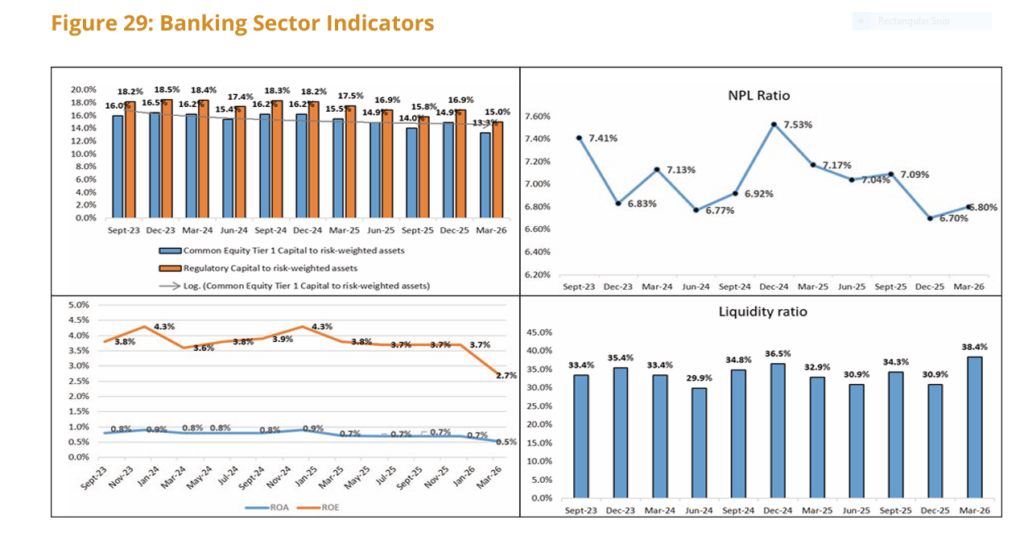
Interest expenses climbed from E293.3 million in March 2025 to E338.6 million in March 2026, representing a 15.4% year-on-year increase. Simultaneously, non-interest expenses experienced a 16.0% increase, rising from E555.8 million to E644.3 million over the same period. This escalation in costs heavily outweighed revenue growth, tighter wrapping the profit margins of local financial institutions, according to Dr. Mnisi.
However, despite this noticeable dip in profitability, the Eswatini banking sector continues to stand on solid ground regarding financial resilience, with liquidity remaining a core pillar of stability. The industry maintained a strong liquidity position throughout the year, tracking comfortably above statutory mandates. As of March 2026, the sector’s overall liquidity ratio stood at 38.4%, reflecting a solid improvement from the 32.9% recorded the previous year.
This performance sits well ahead of the established regulatory minimums, which are pegged at 22.0% for commercial banks and 20.5% for development and savings banks. “While the banking sector performance exhibited a healthy position, there are specific risks and vulnerabilities stemming from individual bank performance,” said Dr.Mnisi. The Governor emphasized that the industry-wide averages mask localized pressures. Acknowledging these isolated pockets of risk, the Central Bank has proactively stepped in.
Dr. Mnisi further confirmed that CBE has deployed necessary remedial measures for specific institutions showing signs of structural vulnerability. These interventions, executed under established legal and regulatory frameworks, are aimed at restoring individual institutional safety and soundness, ensuring the long-term integrity of Eswatini’s financial ecosystem.