
The nation’s leading sugar giants are pivoting away from traditional commodity production toward high-tech industrial diversification.
This strategic transformation comes as industrial players realize that modern agricultural enterprises can no longer survive purely on sugar as a raw commodity. Instead, the future of the industry lies in capturing the full value chain of the circular economy.
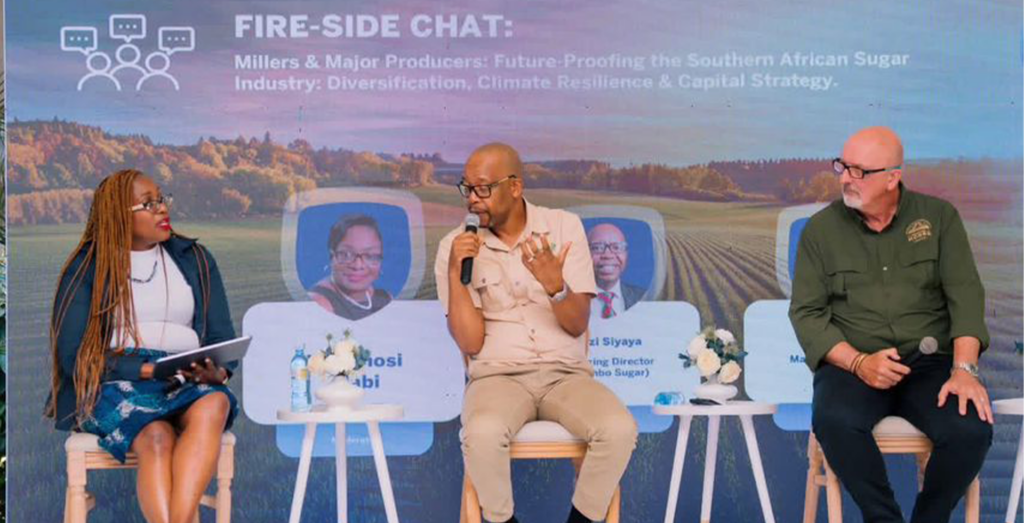
Speaking during an interactive fireside chat at the Standard Bank Regional Sugar Summit held at Simunye Country Club, industry leaders outlined aggressive long-term roadmaps for 2035. The panel revealed a sector-wide repositioning to achieve complete energy self-sufficiency, generate extensive green power for the national grid, and pioneer the production of aviation biofuels like jet fuel from sugarcane.
Ubombo Sugar Limited (USL) has firmly set its sights on 2035 as the definitive timeline for a completely integrated, zero-waste processing model. Addressing the future direction of the business during the fireside session, Ubombo Sugar Limited Managing Director Muzi Siyays emphasized that true commercial sustainability will require an absolute departure from traditional operations.
“Briefly, 2035, a sugar mill must be what we call a circular economy,” Sihawu stated. “It must make its fertilizerfrom the waste. It must produce its own electricity. It must have an energy stream to energy. It must have biofuels in the mix. That sugar mill in 2035 is not a commodity-driven business. That’s where we see the world at, and we are shifting there.”
Siyays acknowledged that while “there’s some work to be done in our country,” the fundamental market demand for sugar, especially in emerging African markets, remains strong. However, he warned that structural adaptation is non-negotiable.
“In 2035, a sugar business just surviving on sugar will not survive,” Siyaya said.
Taking an even more aggressive timeline, the Royal Eswatini Sugar (RES) Corporation revealed that its diversification strategy is already well underway. The corporation aims to split its future profitability equally across three distinct industrial pillars: sugar, energy, and ethanol.
RES Corporation Managing Director Nick Jackson highlighted that the company is leveraging its existing ethanol processing infrastructure to break into cutting-edge global fuel markets.
“I think for us in 2035, we’re a little bit further ahead than Ubombo,” Jackson stated during the chat. “We’ve got an ethanol plant, and we’re already able to make fuel ethanol. We’re just waiting on the mandate, so we’re already good to go on that. We’re even looking now towards turning ethanol into jet fuel. I think in 2035, we’ll be producing jet fuel.”
Jackson projected a highly balanced and resilient corporate balance sheet for the next decade.
“I see our business in 2035 with a third of the profit coming from sugar, a third of the profit coming from power… and a third coming from ethanol, whether that be fuel ethanol for vehicles, whether that be that wonderful elixir called Spirit of Africa, or some of the other brands that we’ll bring out along the way.”
A critical component of this roadmap is absolute energy independence. Jackson announced plans to finalize an imminent energy deal to pull RES completely off the national electricity grid while simultaneously acting as a massive net supplier of green energy to the Eswatini Electricity Company (EEC).

“As I said, we will start an energy project that will see RES come off the grid. Currently, RES is EEC’s single biggest customer. I see us coming off the grid, and at the same time, putting 50 megawatts year-round, based on power, back into the grid.”
According to Jackson, this aggressive diversification ensures long-term institutional resilience. “We will be even more diversified in 2035 than we are today, and that will make us ultimately much more sustainable to employ your children and their children, and their children after that.”
While the industrial vision shared at the Standard Bank summit points toward a high-tech future, the foundation of the industry, the cane growers, are battling immediate, severe macroeconomic pressures that threaten productivity.
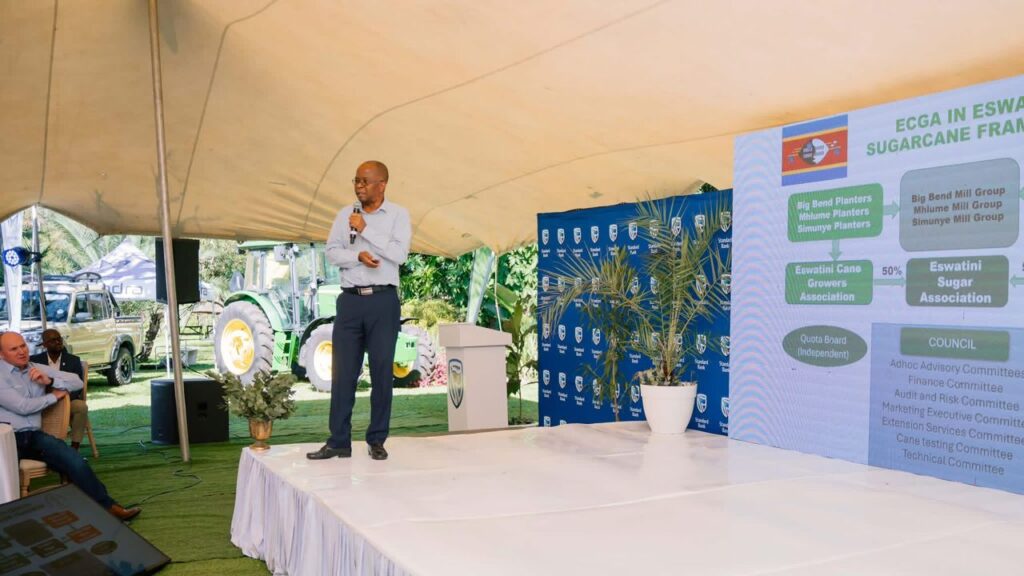
Eswatini Cane Growers Association CEO Dr. Sipho Nkambule provided a sobering look at the localized challenges facing producers, who contribute roughly 70% of the total sucrose processed in the country. Dr. Nkambule revealed a troubling downward trend in yield data, noting that while fields historically produced close to 100 tonnes of cane per hectare, that figure has dipped to hover around 90 tonnes since the 2015/16 season.
A primary driver of this decline is the devastating spike in immediate input costs, specifically power tariffs and fuel prices.
“Some of the issues we are dealing with are input costs,” Dr. Nkambule explained. “We all know it’s history now that electricity went up by another 11%… In the beginning, I think it was the 3rd of February, the cost price of diesel went up, which represented almost 25% of increase. And then, if you add the two together, we went out as growers… that the two together actually increased our production cost by about 11%.”

The financial strain intensified rapidly following subsequent tariff adjustments.
“When I prepared this slide, I kept the 11% in mind and then the new announcement came that electricity is going up. And again, we’ve done a rudimentary combination, which shows that in the space of one month, our cost of production has gone up by about 17%,” Dr. Nkambule noted.
Compounding these economic anxieties is the undeniable impact of climate change, which has not only triggered extreme weather events but has introduced unprecedented biological risks, including the sudden rise of major agricultural pests that were virtually non-existent in previous decades.
Dr. Nkambule concluded that growers must look inward to optimize efficiencies and adapt to these structural shifts, ensuring they can sustainably support the ambitious, multi-pillared industrial future mapped out by the nation’s millers at the Simunye summit.