
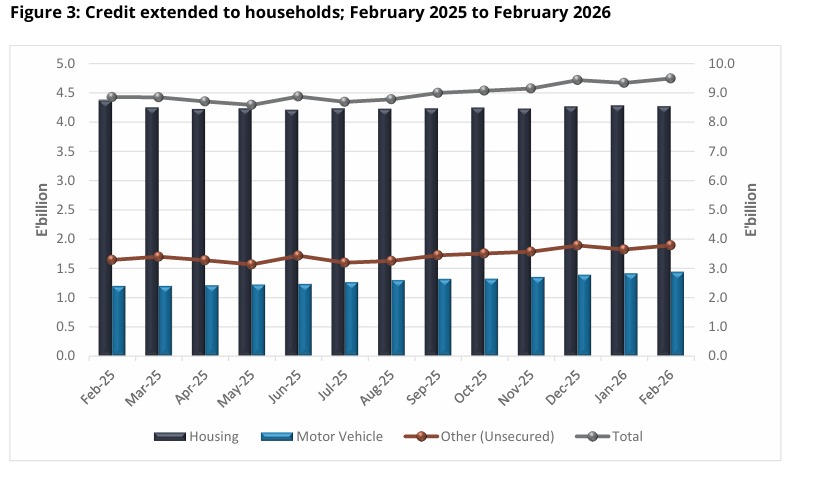
Credit extended to Eswatini’s households and non-profit institutions serving households (NPISH) climbed to E9.5 billion in February 2026, marking a 1.7% increase from the previous month and a 7.2% surge year-on-year.
This is according to the Monthly Statistical Release February/March 2026 released by the Central Bank of Eswatini (CBE).
While overall household debt is rising, the latest data from the CBE reveals a significant shift in how citizens are managing their finances, with a notable move away from traditional long-term property investments toward immediate liquidity and shorter-term borrowing. The primary driver behind the rising debt levels was a sharp increase in other personal (unsecured) lending, which grew by 4.0% to reach E3.8 billion. Motor vehicle financing also saw a boost, increasing by 1.6% to close the month at E1.4 billion.
In contrast, the appetite for home ownership appeared to cool slightly. Housing loans, which typically represent the largest portion of household credit, saw a marginal contraction of 0.3%, falling to E4.3 billion. This decline partially offset the broader gains seen in personal and vehicle credit.
The growth in household debt is part of a wider expansion in private sector credit, which reached E22.9 billion in February, higher by 2.5% month-on-month and 6.7% year-on-year.
The business sector proved to be a major engine of this growth, with credit increasing by 3.1% month-on-month and 6.9% year-on-year to close at E12.3 billion. This expansion was characterized by broad-based sectoral gains:
- Manufacturing led the surge with an 8.8% increase.
- Construction followed with 7.5% growth.
- Transport & Communications rose by 2.5%.
- Community, Social & Personal Services, and Distribution & Tourism both grew by 1.3%.
- Real Estate credit increased by 1.2%.

These gains were partially offset by credit declines in Mining & Quarrying (down 2.8%) and Agriculture & Forestry (down 1.2%). Notably, both Small & Medium Enterprises (SMEs) and large enterprises improved during the month. Credit to SMEs rose by 5.1% to E4.1 billion (33.2% of total business credit), while large enterprises expanded by 2.2% to reach E8.2 billion.
Credit extended to other domestic sectors stood at E1.1 billion, reflecting growth of 2.4% month-on-month and 1.2% year-on-year. This was driven by credit to other financial corporations and parastatals, which grew by 5.1% to E530.3 million and 0.3% to E500.0 million, respectively. However, this improvement was moderated by a 1.5% decline in credit to local government, which fell to E83.0 million.
Despite the increase in borrowing, the banking sector maintains a healthy liquidity position, although the liquidity of the industry contracted by 12.9% month-on-month to reach E9.2 billion. The liquidity ratio fell to 34.5% in February 2026, from 37.6% in January.