

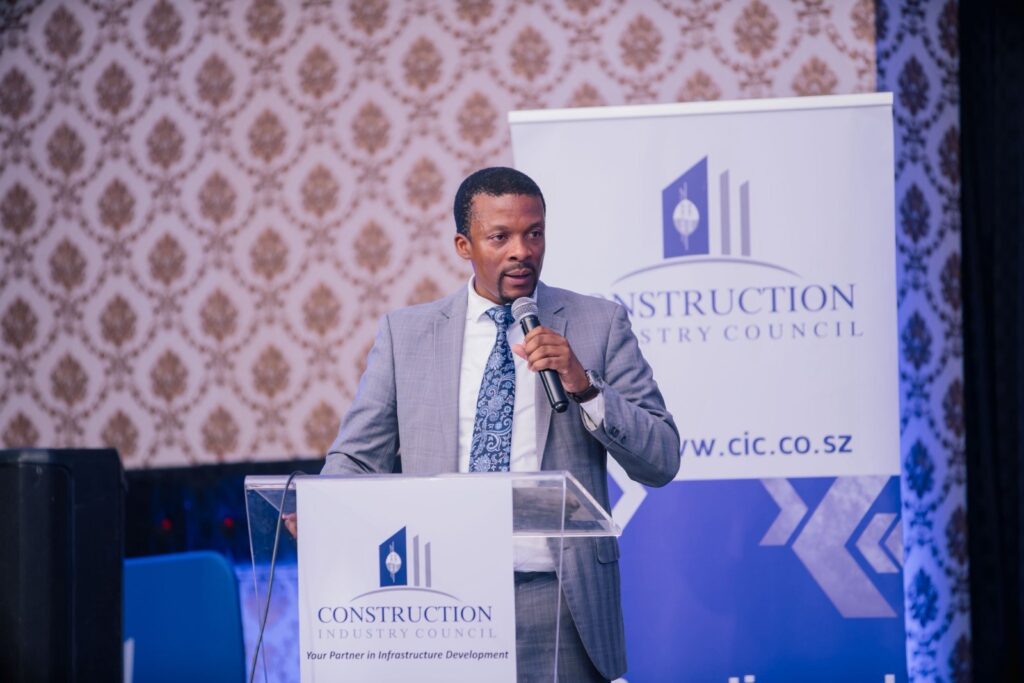
Our conversation with Maqhawe Mnisi, the CEO of the Construction Industry Council (CIC), lasted 1 hour and 5 minutes. During that time, we gained firsthand insight and appreciation for Mnisi and his team’s passion for encouraging and promoting local contractor participation in construction projects across the country. This, of course, contradicts what stakeholders have said, most recently about the Mpakeni Dam project, which caused significant uproar across the industry and the country as a whole. Mnisi, while accepting the criticism, notes that several factors contribute to these challenges, some of which are external and beyond the Council’s control. Dive into the article to learn more about the Council’s initiatives on this urgent issue and other relevant topics like the decline in projects nationwide.
The construction industry plays a vital role in the local economy, contributing over E2.6 billion annually. How have you found leading such an influential organization?
It has been challenging mainly because I assumed office when our local economy was experiencing slow growth. You will understand that for the construction industry to thrive, the economy needs to perform well. It’s also important to note that slow economic growth isn’t unique to Eswatini; it’s happening across the region. This has led to fewer projects and opportunities for contractors and individual artisans. Sadly, some companies have even shut down.
Some people argue that the establishment of the CIC led to the closure of those companies. Is that a fair point?
As previously mentioned, the CIC was established during a period of economic hardship, yet most capital projects are mainly funded through government spending. It’s also important to note that the government declared a fiscal crisis in 2014, which significantly affected the industry. Interestingly, the CIC was introduced around the same time. The claim that companies closed because of the CIC is incorrect. While it’s important to respect people’s opinions on this matter, we also need to understand why the Council was created, what its role is, and what its purpose entails. It’s important to note that the creation of the CIC was driven by stakeholders who recognized the need for a regulated industry. Some may initially resist, but over time, they come to understand and appreciate the role of a regulator.
Please give more details about the Council’s role and mandate.
The CIC aims to enhance competitiveness and excellence in Eswatini’s construction industry over the medium to long term. We are committed to empowering industry players and project owners. An important role is adding value to the industry, and we work to ensure contractors truly feel that value. Currently, our focus is on equipping local contractors to meet project owners’ expectations. The sustainability and profitability of contractors is vital to us because that is how the industry will grow over time.
The awarding of major infrastructure projects to international firms remains a contentious issue. From the CIC’s perspective, what are the root causes? And what steps are being taken to enhance the capacity and competitiveness of local contractors?
The root causes are primarily due to legislative gaps and the government’s cash flow situation. From a legislative perspective, there is a need to harmonize government laws to close existing gaps and clearly define expectations for local empowerment. As mentioned earlier, because of the challenging economic environment, most large scale projects are funded through external debt. Unfortunately, that external debt comes with terms and conditions that aren’t favourable to local contractors. We have engaged the government, particularly the Ministry of Finance to ensure that the CIC is involved in ongoing negotiations. During that negotiation period, the Ministry and the CIC should work closely together, as we understand the current skills available on the ground.
On a positive note, three key pieces of legislation, once finalized, will bring clarity and strengthen local empowerment efforts; the CIC Act and Procurement Acts are under review, while the Citizen Economic Empowerment Act was enacted in 2024. Finalizing the Regulations of the Citizens Empowerment Act will help accelerate its implementation.
I want to pay special tribute to His Majesty King Mswati III for his advocacy on behalf of local contractors. His leadership, as highlighted in the Speech from the Throne, underscored the importance of increasing local participation in infrastructure development. Additionally, the Council has engaged both the public and private sectors to find the best ways to support this greater local involvement. This has produced positive results, as the Council has played a key role in ensuring that EmaSwati companies participate in several projects, including the construction of the Central Bank of Eswatini (CBE) Headquarters, the National Oil Strategic Reserve facility, the Eswatini Water & Agricultural Development Enterprise (EWADE), and the Eswatini Water Services Corporation (EWSC) projects. We have witnessed increased commitment from the Government and Parliament, starting with their willingness to work with CIC and their support for boosting local participation. Thus, we believe this form of engagement and desire will lead to increased local participation.
Some project owners argue that local contractors aren’t competitive enough, leading to projects being awarded to foreign companies. Is this accurate?


One must be careful when responding to this question, lest it be taken out of context. I say this because, to some extent, it is true: some projects require specialized skills which we may not have in the country. There are skills gaps in local construction companies, which is not unique to Eswatini. However, this is where the CIC becomes very important. The Ministry of Public Works & Transport has, for example, raised concerns about our local contractors’ ability to prepare tender documents to the expected standard. But that is only part of the process; we also focus heavily on helping local contractors ensure they deliver projects on time and as promised.
In the same breath, local companies have clearly proven their ability and competitiveness. I would confidently say that local contractors and consultants are capable enough to handle large scale projects. Some notable large scale projects include Maguga Dam, the First National Bank headquarters and the Public Service Pensions Fund’s ESASCCO Building, among others.
The CBE has complimented the Council for its involvement on its ongoing Headquarters project. How did you approach this project to ensure local contractors could take part?
The CBE headquarters serves as our blueprint project for involving local contractors in large-scale initiatives. From the start, we collaborated with industry players to find ways to involve them in the project. We even recommended they consider joint ventures with either local or international contractors. The CBE team was also contacted early on and was informed of our goals for the project to benefit the local industry. Fortunately, the CBE team has been very cooperative and transparent. The most rewarding aspect is what this project will do for local contractors, as I mentioned earlier: government projects are rare.
The Council released the Eswatini Construction Access to Credit Report in 2023, which noted that about 36% of local contractors have difficulty obtaining financing. Has there been any progress for local contractors in this area?
There has been little progress in that area. There are several reasons for this. We have observed that commercial banks still view the industry as high risk due to factors such as delayed government payments and the difficulty of predicting future projects. Because of this, we are working on specific initiatives to address this major issue. One of the initiatives the Council is developing is the creation of a Construction Industry Fund to encourage more local companies to participate in both public and private infrastructure tenders. This will tackle one of the industry’s biggest challenges—access to financing. We have engaged various public and private stakeholders to gauge their interest in partnering with the Council to establish a strategic fund, and the response has been positive. We are currently assessing the feasibility of making this a reality, but we cannot share more details at this time.

What actions is the CIC taking to support small and medium-sized businesses in the industry, especially given the concern that large contractors dominate most major projects?
Firstly, let me acknowledge that the local industry is oligopolistic, with a few large companies securing most tenders and receiving the majority of the work, especially in the public sector. In contrast, smaller companies tend to receive a smaller share, mainly through subcontracting. That said, it is essential to note that many smaller contractors gain jobs through government agencies like Micro-Projects. Should smaller contractors also take on a more significant role in major projects? Without a doubt, that’s why we work to empower them, support their growth, and help them stay profitable in the long run. Our goal as a Council is to promote competitiveness and excellence within the industry, and we pursue this through the following strategic imperatives.
Promoting the industry
We have been actively engaging key government ministries, with the support of the Honourable Minister of Public Works & Transport (MOPWT), the Principal Secretary, and the Ministry of Finance. Our goal is to reduce barriers to doing business in the sector and support local empowerment by providing construction opportunities that prioritize local participation. The MOPWT has taken the lead by releasing tenders for roads and bridges during this financial year, which also gives small contractors a chance and encourages sourcing construction materials locally. The Micro-Projects program, focused on developing community infrastructure, has been central to the growth and sustainability of SMMEs. The Council monitors the allocation of work awarded through Micro-Projects and ensures that work is assigned to appropriate categories, promoting participation from smaller contractors. These are just some examples; the same approach applies across all procuring entities or project owners with whom we work.
Training and Capacity Building Initiatives
We have supported contractor training in areas where they still lack the necessary skills to remain competitive and achieve excellence that satisfies the project owner. It is worth noting that there is room for improvement in this area. The Council also targets industry players in the informal sector by supporting the development of artisans’ skills in various trades such as electricians, plumbers, bricklayers, and carpenters.
This ensures they achieve a certain level of proficiency and enables them to start their own businesses, equipping them with the necessary skills to operate profitably and meet client expectations. EmaSwati are encouraged to hire CIC-registered artisans who hold Grade 1, 2, or 3 Grade-tested certificates, even when building residential structures, as it guarantees a level of competency. The proposed Construction Industry Fund will be designed to promote the involvement of all contractors, primarily by lowering high tender requirements such as bid bonds and performance securities.
Regulation is often viewed as both an enabler and a challenge. How does the CIC find the right balance between enforcement and development?
The Council’s core mandate is supported by three pillars that guide operations and service delivery: promoting, developing, and regulating the industry. To maintain that delicate balance and follow through, we have developed a 3-year strategy that turns our intentions into action through our strategic approach/theme, CIC: empowering and enabling the construction industry.
Smaller contractors and individual artisans often say that the annual registration renewal fees are expensive and the process is complicated. What is your take on that?
While acknowledging their valid concerns, it is important to note that the Council has actively reduced registration fees by over 15 percent over time. Smaller contractors should also consider the benefits of regulation that I mentioned earlier. One such benefit is the alternative dispute resolution service offered to project owners, contractors, and consultants. This service is especially valuable for smaller contractors and artisans, who often lack formal contracts or have unclear agreements, which can lead to issues when conflicts arise. The costs are covered by the Council and are provided free of charge to those seeking dispute resolution, helping them avoid the higher costs of immediately engaging arbitrators or courts.
Does the CIC have authority over housing projects built on Eswatini Nation Land, and are individual artisans required to register with the Council when constructing houses on such land?
Indeed, the Council has jurisdiction over Eswatini Nation Land, and individual artisans must be registered. We have started, and are in the planning stages of an initiative to collaborate with the Ministry of Tinkhundla to “take the Service to the people,” our Year 2025 service delivery theme. We have planned several initiatives to encourage increased, community-led participation by contractors and artisans in construction projects, both community-based and large national projects. We have also begun working with institutions such as NDMA and Micro-Projects to boost community-level empowerment.
We have seen the Council collaborating with external institutions such as the United Nations Development Programme (UNDP) Eswatini, and local Municipalities to empower young people in the construction industry. Please share with us the motivation behind this effort and the results you have observed.
These initiatives began last financial year after we engaged with the industry and received feedback indicating that, regarding labor market supply issues, the skill level of graduates entering the workforce was not meeting expectations when construction companies hired them. Therefore, we saw an opportunity to partner with UNDP Eswatini and leverage its Eswatini Youth Empowerment Programme (EYEP) program to address industry challenges. There are other initiatives at the planning stage aimed at youth, where we are partnering with MOPWT, Micro-Projects, and some municipalities under the Local Economic Development program.

We understand that efforts are underway to develop a Public-Private Partnership (PPP) policy to increase private-sector involvement in infrastructure delivery. Besides this initiative, are there other policy reforms or strategic frameworks in development aimed at transforming and modernizing Eswatini’s construction industry?
Yes, the Council is finalizing a revised Construction Industry Policy (CIC, Architects, Engineers, Surveyors & Allied Professionals (AESAP) Act, and regulations) with reforms aimed at creating a supportive environment, ensuring fair competition for all industry participants, and preparing for and responding to emerging and future developments to benefit the industry and project owners.
Where do you see the biggest opportunities for growth in Eswatini’s construction and property sectors over the next five years?
There are several, but one of the main ones we are excited about is the Sectional Title Act of 2003, which promotes infrastructure development in local urban areas. Once fully implemented, the Act will create significant opportunities for contractors, individual artisans, and the industry as a whole. The Citizenship Economic Empowerment Act, in accordance with the Procurement Act and CIC Act, will also open the industry for local empowerment and participation.
On a personal note, what fuels your passion for the construction and built environment sector?
I must emphasize that I have an outstanding team supporting me, who ensure we fulfill our mission. My passion is to ensure that the dedicated and exceptional CIC staff are continuously empowered to deliver excellent customer service and achieve customer satisfaction. Our goal is to create a level playing field where obstacles are removed and to develop a highly competent sector where industry produces world-class infrastructure and companies experience growth, profitability, and sustainability. We strive to help local construction companies become competitive and excel, satisfying project owners by ensuring construction projects achieve operational cash flow, profitability, growth, and sustainability. We also focus on increasing the participation of youth, women, and people with disabilities in construction and on promoting user-friendly infrastructure. Additionally, we work to ensure adaptation to climate change initiatives, including the development of climate-smart infrastructure in urban and residential areas.
Your job is undoubtedly demanding. What do you do to unwind?
I am an avid football fan and support the biggest team in South Africa; I won’t say which one because everyone knows which team it is (hahaha). I have also developed a new passion for golf; it helps me release a lot of tension. It also allows me to network with leaders from other industries, which is essential because construction is a multidisciplinary field.
CEO, thank you very much for your time and honesty.
It’s been a pleasure.