
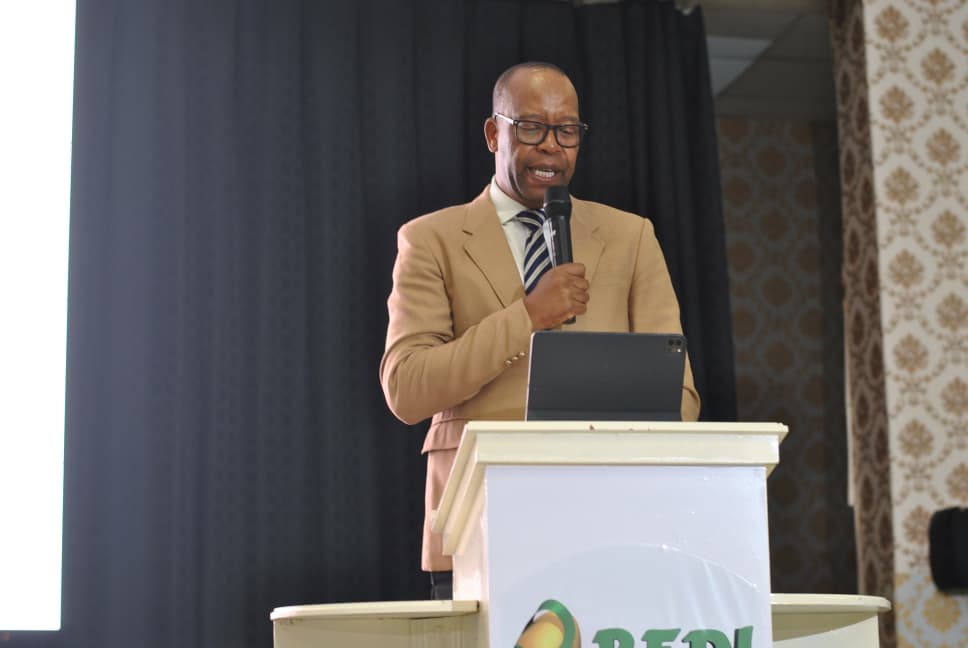
The Managing Director of Ubombo Sugar Limited, Muzi Siyaya, has called for urgent reforms in Eswatini’s corporate governance culture, warning that the persistence of boardroom nepotism, political appointments, and overstaying directors threatens effective governance and accountability.
Speaking at the REDI Governance Dialogue on Thursday, Siyaya said it is time for the country to embrace renewal, merit, and professionalism in board appointments, principles included in the new King V Draft Code for Corporate Governance.
The dialogue, hosted by REDI, was titled HIGHLIGHTS OF KING V: ESWATINI RESPONSE and explored how the new King V framework, anchored in ethics, transparency, and sustainability, can reshape leadership practices in Eswatini.
“Too often, board seats and senior roles are awarded not on merit but on proximity to power, friendship, or influence,” he said. “This culture weakens institutions, discourages qualified professionals, and erodes public confidence in corporate governance.”
He praised the Public Enterprise Unit (PEU) for its recent initiative to develop a national database of qualified professionals for board appointments, describing it as “a significant reform that promotes transparency, diversity, and merit-based selection.”
King V, he explained, provides a framework for good governance that extends beyond compliance to include ethical and effective leadership. Its first pillar (Board Tenure, Renewal, and Appointments) advocates for a three-term limit (three renewable three-year terms) to ensure “oversight with fresh perspectives.”
“Effective governance requires independence of mind, sustained through structured renewal,” he said. “But renewal alone is not enough; we must also address the deeper culture of cronyism that has crept into boardrooms.”



He added that reappointing the same individuals to multiple boards undermines institutional performance and limits opportunities for emerging professionals.
“When you start sitting on more than five boards, you cannot be effective,” he noted. “It’s not just a way of earning a living; it’s a responsibility that requires diligence and preparation.”
He urged both the public and private sectors to move away from patronage-based appointments and instead prioritize competence, diversity, and ethics.
Siyaya warned against the growing tendency for some boards to overstep their oversight role and interfere with management functions, which he said blurs lines of accountability.
“King V reminds us that boards govern, management executes. Oversight must guide and empower, not paralyze,” he said. “A respectful partnership between boards and management is vital; one built on trust, accountability, and clearly defined boundaries.”
Highlighting lessons from South Africa’s corporate scandals (such as Steinhoff and Eskom) and local cases (Status Capital and Ecsponent), Siyaya warned that weak governance and patronage networks destroy institutions.
“At the core of all these failures lie two common issues: oversight and competence. Boards that grow too comfortable lose their critical edge. Oversight without independence becomes endorsement,” he cautioned.
He stressed that Eswatini must institutionalize merit-based appointments and build the courage to ask hard questions, even when the answers are uncomfortable. He emphasized that King V places strong emphasis on board competence and ethical leadership, calling for directors who possess the right mix of financial, strategic, technological, and sustainability skills.
“We must entrench merit-based appointments, maintain professional distance between boards and management, and build the courage to ask hard questions, especially when the answers are uncomfortable,” he said. “Competence means having people who can challenge management constructively and make informed decisions.”